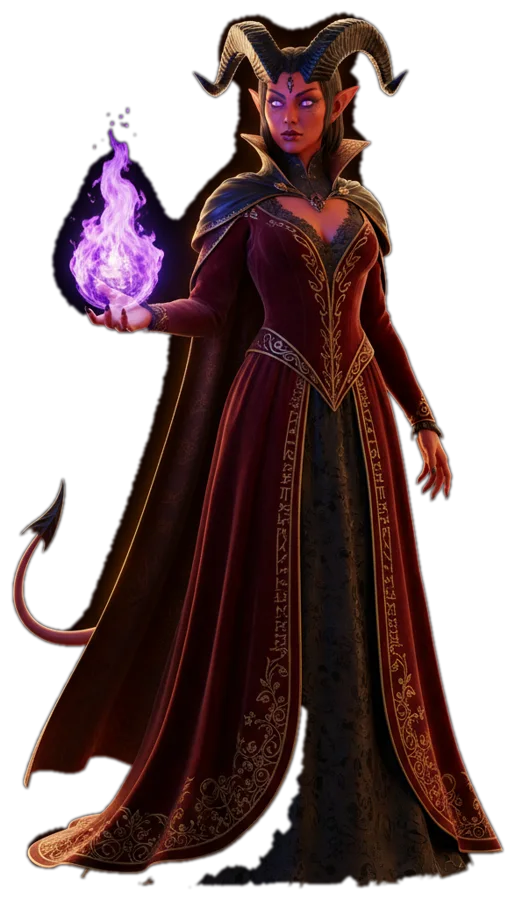
Tieflings receive one name at birth and choose a second the day they decide what they are. The grimoire records both kinds and takes no position on which is truer, though it notes that only one of them was picked by somebody who had met the tiefling in question.
Blood-names carry the old infernal music: sibilants, dark vowels, stress held late like a breath. Akaria, Malzar, Xulos. Their meanings run to cinders, pacts, and debts, the accounting vocabulary of the deep courts. Many tieflings wear these names comfortably, the way one wears an inherited coat: it fits, whoever bought it.
The virtue name is the tiefling invention the other peoples quietly envy. Sorrow. Creed. Excellence. Quiet. A single common word, worn like armor, announcing the one law that tiefling has chosen to live by. It is considered deeply rude to ask whether the name is aspiration or achievement. It is always both.
A word on using both names at the table. Most tieflings the grimoire has recorded keep the blood-name for documents and the virtue name for the door. A party that learns the blood-name of its tiefling has been handed a small ceremony: it is used in two situations only, by enemies who researched too well, and by friends at moments when nothing lighter would do. A DM who remembers this rule owns a free dramatic instrument that costs no preparation at all.
The virtue names deserve more respect than they get. Sorrow, Creed, Excellence, Quiet: these read as words but function as arguments. Each one is the tiefling telling the world what it intends to prove or refuse. The grimoire suggests choosing the virtue name against the grain of the character sheet. A barbarian named Mercy and a swindler named Honest both walk into the session carrying their own story hook, already lit.
Pronunciation, briefly. Infernal stress lands late: a-KA-ria, not AK-aria. Hold the last long vowel a half-beat past comfortable and the name sounds inherited rather than invented. If the table laughs the first time, the archivist notes, they will not laugh the fifth.
The elements of the old tongue
Aka- cinder
Bel- tyrant's due
Dam- bound oath
Eke- whisper of doubt
Ira- wrath
Kai- broken chain
Lev- rising smoke
Mal- ill-starred
Nem- debt unpaid
Oro- burnt gold
Sza- serpent-tongue
Val- worth proven
Female Tiefling Names
- Iraeshka "wrath little blade"
- Zaranthe "sealed pact bloom in ruin"
- Nemora "debt unpaid ember-crowned"
- Beleth "tyrant's due veiled"
- Akaissa "cinder smoke-dancer"
- Nemeshka "debt unpaid little blade"
- Xulyri "forbidden word ash-eyed"
- Oroix "burnt gold sharp-sworn"
- Theyri "godless ash-eyed"
- Damria "bound oath night-flower"
- Nemaia "debt unpaid unburned"
- Damyri "bound oath ash-eyed"
- Valune "worth proven moonless"
- Leveth "rising smoke veiled"
- Zareth "sealed pact veiled"
- Dameth "bound oath veiled"
Male Tiefling Names
- Valai "worth proven twice-born"
- Rivzar "torn page sealed"
- Nemos "debt unpaid of the deep courts"
- Xulros "forbidden word horn-crowned"
- Szaeus "serpent-tongue pact-holder"
- Damim "bound oath marked"
- Iraeth "wrath veiled"
- Valeus "worth proven pact-holder"
- Nemeth "debt unpaid veiled"
- Kaiai "broken chain twice-born"
- Zarim "sealed pact marked"
- Iraros "wrath horn-crowned"
- Valros "worth proven horn-crowned"
- Xulim "forbidden word marked"
- Thezar "godless sealed"
- Valzar "worth proven sealed"
Noble Tiefling Names
- Orois "burnt gold between worlds"
- Valur "worth proven old fire"
- Oroex "burnt gold cast out"
- Valis "worth proven between worlds"
- Belur "tyrant's due old fire"
- Oroan "burnt gold wanderer"
- Zarex "sealed pact cast out"
- Valan "worth proven wanderer"
- Belis "tyrant's due between worlds"
- Valex "worth proven cast out"
Margin notes
Why do some tieflings have names like 'Sorrow' or 'Creed'?
These are virtue names: a chosen single-word name declaring the concept the tiefling has decided to embody. The custom appears in the 5e lore and has become the culture's signature. Choosing one is a rite; explaining one is optional.
Should my tiefling use their infernal name or a virtue name?
Many use both: the blood-name for family and enemies, the virtue name for the life they are building. A tiefling who gives you the infernal name first is telling you which one they expect you to become.
What do tiefling names sound like?
Infernal blood-names favor sibilants and dark vowels with late stress: Szaeth, Nemara, Zarakas. If it sounds like a held breath or a sealed contract, it is on key.
Should my tiefling use a blood-name or a virtue name?
Carry both. The virtue name is the public argument, the blood-name is the reserved instrument, and the difference between them is a roleplay lever you get for free. Pick the virtue name against your class stereotype for a hook that introduces itself.
Last inscribed 2026-10-01