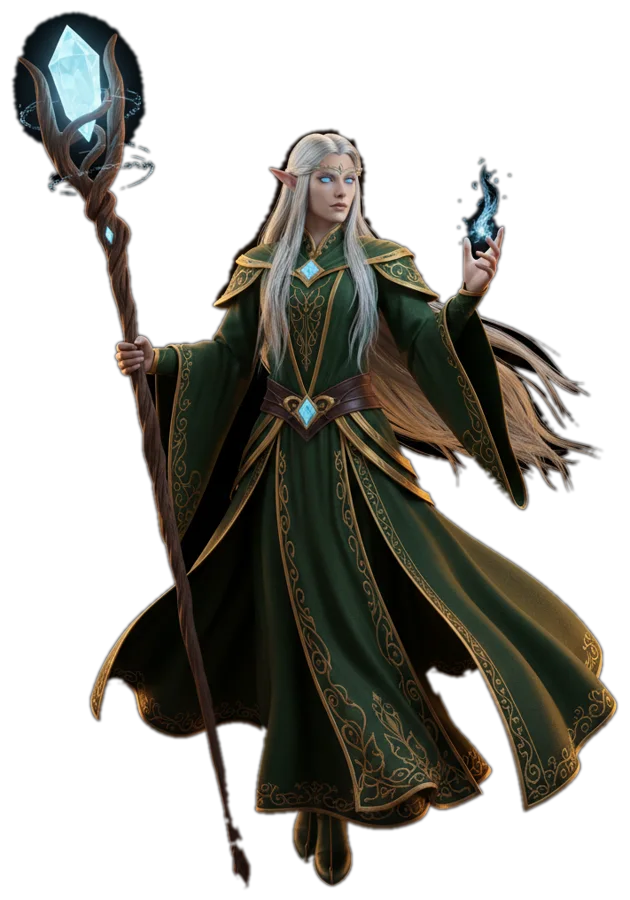
Elvish names are not chosen. They are remembered, the way one remembers a piece of music: the family hears the first syllables of a child's name years before the child arrives. This is why an elf will wince, politely, when a human introduces themselves as something practical like Bram. To elvish ears a name without melody is a door without a room.
The old tongue builds every name from two remembered things: a light and a shape. Aelwen is twilight and a fair maiden; Sylras is forest-shadow and swiftness. High families favor long vowels and the liquid consonants, l and r and th, sounds that pour rather than knock. Wood-kin clip their names shorter, and the grey exiles of the coasts choose sorrow-sweet sounds the way other folk wear mourning colors.
Family names among elves are landscape and weather, remembered in the common tongue so outsiders can pronounce at least half of an introduction: Moonwhisper, Silverbrook, Evenveil. An elf's full name is a small map of where their line has stood and what light it stood in. Ask about one and you will receive a story two hundred years long, so budget your evening accordingly.
The elements of the old tongue
Ael- twilight
Aur- dawn-gold
Cael- clear sky
Elo- star
Fae- spirit
Gala- radiance
Ily- moonlit
Lith- ash-grey
Lua- song
Myr- sea-born
Nae- sorrow-sweet
Ola- leaf
Female Elf Names
- Riaithe Brightwhisper "crown of flowers whisper"; the bright-whisper line
- Faeara Moonwhisper "spirit royal"; the moon-whisper line
- Faeanna Swiftbrook "spirit gift"; the swift-brook line
- Yllathiel Silverbrook "old light daughter of"; the silver-brook line
- Sylwen Greenwanderer "forest shadow maiden, fair"; the green-wanderer line
- Rialia Swiftbloom "crown of flowers bloom"; the swift-bloom line
- Quelathiel Greensong "silver daughter of"; the green-song line
- Vaewen Evensong "wind maiden, fair"; the evening-song line
- Naewen Evenveil "sorrow-sweet maiden, fair"; the evening-veil line
- Quelwen Evenbloom "silver maiden, fair"; the evening-bloom line
- Olariel Swiftgaze "leaf garlanded one"; the swift-gaze line
- Yllara Moonshadow "old light royal"; the moon-shadow line
- Elonara Dawnwhisper "star flame kept"; the dawn-whisper line
- Luathiel Swiftwanderer "song daughter of"; the swift-wanderer line
- Faewen Silverspear "spirit maiden, fair"; the silver-spear line
- Riara Brightleaf "crown of flowers royal"; the bright-leaf line
Male Elf Names
- Sylion Starveil "forest shadow son of"; the star-veil line
- Syllas Swiftleaf "forest shadow leaf-son"; the swift-leaf line
- Myrlas Moonspear "sea-born leaf-son"; the moon-spear line
- Vaelas Windwanderer "wind leaf-son"; the wind-wanderer line
- Thalrion Brightleaf "tall pine crowned"; the bright-leaf line
- Galavain Silverbloom "radiance fair-made"; the silver-bloom line
- Naemar Swiftgaze "sorrow-sweet dweller"; the swift-gaze line
- Yllorn Brightbrook "old light tree-strong"; the bright-brook line
- Thalorn Evenshadow "tall pine tree-strong"; the evening-shadow line
- Aelathir Greenwanderer "twilight keen-eyed"; the green-wanderer line
- Vaemar Silverveil "wind dweller"; the silver-veil line
- Queldir Greenveil "silver watcher"; the green-veil line
- Naendil Windwhisper "sorrow-sweet devoted to"; the wind-whisper line
- Aurrion Silversong "dawn-gold crowned"; the silver-song line
- Luaras Stargaze "song swift"; the star-gaze line
- Galaras Greenbrook "radiance swift"; the green-brook line
Noble Elf Names
- Riael "crown of flowers beloved"
- Galael "radiance beloved"
- Aurel "dawn-gold of the stars"
- Yllen "old light green"
- Galaith "radiance small light"
- Aurael "dawn-gold beloved"
- Galair "radiance shining"
- Yllir "old light shining"
- Quelir "silver shining"
- Yllith "old light small light"
Margin notes
How do elf names work in D&D 5e?
Most tables give an elf a melodic personal name and a nature-compound family name (Moonwhisper, Silverbrook). Subrace flavors the sound: high elves favor long formal names, wood elves clip them shorter, and drow lines darken the vowels. Every name this grimoire deals follows that structure and carries its meaning with it.
Can I rename my elf mid-campaign?
In elvish custom a renaming is a serious rite reserved for a life remade: an exile, an oath, a resurrection. Mechanically, of course, your DM will allow it. Narratively, make the old name a scar the character still answers to when shouted.
What makes an elf name sound authentic?
Liquid consonants (l, r, th, s), open vowels, and stress on the first syllable. If it pours instead of knocks, it is elvish. If it knocks, hand it to a dwarf.
Last inscribed 2026-10-01