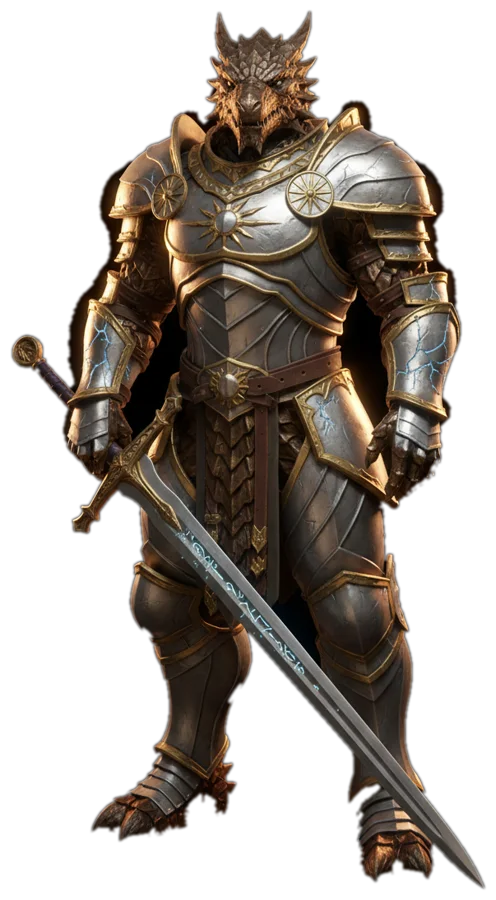
A dragonborn gives the clan name first, as a shield, and the personal name second, as a gift. To reverse the order is to tell a stranger you trust them more than your ancestors, which dragonborn do exactly once in a lifetime, and usually at a wedding.
Clan names are long deliberately: Kepeshkmolik, Daardendrian, Clethtinthiallor. They are worn like banners and pronounced in full at every formal occasion, however long the occasion consequently becomes. Each carries a compressed founding story, the unbroken line, keepers of the first flame, and reciting them correctly is how young dragonborn prove they are worth the shield.
Personal names crack and hiss, scale on stone: Ghesh, Kriva, Vrakan. Meanings run to breath, wing, and weather. Among close kin a dragonborn may be called by a hatchling nickname instead, but the grimoire has been asked, firmly, not to record those.
The elements of the old tongue
Arj- bright scale
Bala- storm-wing
Dona- gift of the clan
Ghesh- breath of fire
Hesk- winter-scale
Kriv- keen fang
Medr- patient hunter
Nadar- sky-borne
Pand- shield-brother
Rho- ember-heart
Shed- molted, renewed
Tarh- mountain wind
Female Dragonborn Names
- Nemmonis Vrakethe "thunder-jaw long-memory"; of clan Nemmonis, sworn to no throne
- Clethtinthiallor Rhoissi "ember-heart small storm"; of clan Clethtinthiallor, the unbroken line
- Clethtinthiallor Nadarasha "sky-borne sun-warmed"; of clan Clethtinthiallor, the unbroken line
- Clethtinthiallor Uadjola "river-jade hoard-keeper"; of clan Clethtinthiallor, the unbroken line
- Yarjerit Pandola "shield-brother hoard-keeper"; of clan Yarjerit, wing-sworn kin
- Kepeshkmolik Pandira "shield-brother keen-eyed"; of clan Kepeshkmolik, stone-patient
- Kepeshkmolik Uadjynn "river-jade wind-song"; of clan Kepeshkmolik, stone-patient
- Kepeshkmolik Medrethe "patient hunter long-memory"; of clan Kepeshkmolik, stone-patient
- Myastan Nadarethe "sky-borne long-memory"; of clan Myastan, watchers of the pass
- Myastan Pandynn "shield-brother wind-song"; of clan Myastan, watchers of the pass
- Yarjerit Qelola "quiet flame hoard-keeper"; of clan Yarjerit, wing-sworn kin
- Nemmonis Vrakola "thunder-jaw hoard-keeper"; of clan Nemmonis, sworn to no throne
- Myastan Medrissi "patient hunter small storm"; of clan Myastan, watchers of the pass
- Delmirev Vrakasha "thunder-jaw sun-warmed"; of clan Delmirev, river of silver scales
- Linxakasendalor Balaira "storm-wing keen-eyed"; of clan Linxakasendalor, gold beyond counting
- Delmirev Donasha "gift of the clan sun-warmed"; of clan Delmirev, river of silver scales
Male Dragonborn Names
- Daardendrian Vrakor "thunder-jaw mountain-son"; of clan Daardendrian, keepers of the first flame
- Yarjerit Heskosh "winter-scale deep-voiced"; of clan Yarjerit, wing-sworn kin
- Yarjerit Medran "patient hunter firstborn"; of clan Yarjerit, wing-sworn kin
- Kimbatuul Balash "storm-wing of the ash-wind"; of clan Kimbatuul, storm-descended
- Clethtinthiallor Tarhash "mountain wind of the ash-wind"; of clan Clethtinthiallor, the unbroken line
- Norixius Gheshan "breath of fire firstborn"; of clan Norixius, law of the old wyrms
- Kimbatuul Medrosh "patient hunter deep-voiced"; of clan Kimbatuul, storm-descended
- Myastan Uadjash "river-jade of the ash-wind"; of clan Myastan, watchers of the pass
- Nemmonis Donarek "gift of the clan breaker of lines"; of clan Nemmonis, sworn to no throne
- Kimbatuul Tarhan "mountain wind firstborn"; of clan Kimbatuul, storm-descended
- Kepeshkmolik Nadarash "sky-borne of the ash-wind"; of clan Kepeshkmolik, stone-patient
- Nemmonis Gheshash "breath of fire of the ash-wind"; of clan Nemmonis, sworn to no throne
- Yarjerit Medrrek "patient hunter breaker of lines"; of clan Yarjerit, wing-sworn kin
- Linxakasendalor Qelor "quiet flame mountain-son"; of clan Linxakasendalor, gold beyond counting
- Nemmonis Shedur "molted, renewed elder-blood"; of clan Nemmonis, sworn to no throne
- Kepeshkmolik Zedor "gold-keeper mountain-son"; of clan Kepeshkmolik, stone-patient
Noble Dragonborn Names
- Zedesh "gold-keeper between winds"
- Donax "gift of the clan sharp"
- Zedax "gold-keeper sharp"
- Donaynn "gift of the clan wind-song"
- Nadarynn "sky-borne wind-song"
- Nadarax "sky-borne sharp"
- Nadaresh "sky-borne between winds"
- Donaesh "gift of the clan between winds"
- Zedynn "gold-keeper wind-song"
- Zedil "gold-keeper young scale"
Margin notes
Why does the clan name come first for dragonborn?
Loyalty runs clan-first in the culture: the clan is shield and law, the self is second. Introductions follow suit: Kepeshkmolik Ghesh, never Ghesh Kepeshkmolik, unless the speaker intends the insult.
How do I pronounce the long clan names?
Break them into hammer-strokes and do not rush: Ke-peshk-mo-lik. The grimoire deals pronunciation with every name; at the table, commit to a reading and never apologize. Confidence is canon.
Do dragonborn have gendered names?
Personal names lean by sound rather than rule: -ara and -ynn endings ring feminine, -rek and -osh masculine, but clans care about the deed, not the ending.
Last inscribed 2026-10-01