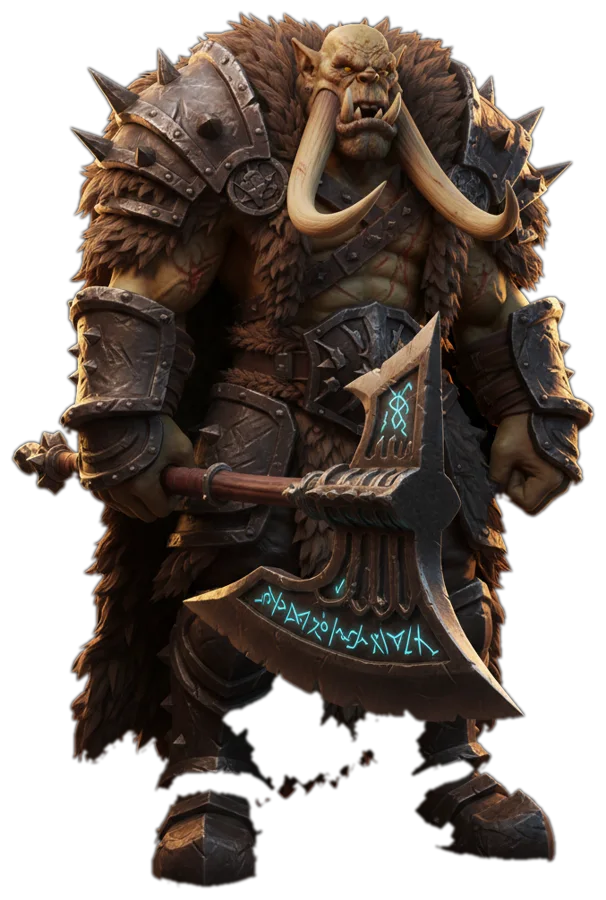
Orcish names are not given. They are taken, and held for exactly as long as they can be defended. A weak orc with a strong name will be relieved of it, publicly, and issued something more accurate. This makes orcish introductions refreshingly honest, and orcish census-taking a contact sport.
The sounds are built to survive weather and war: guttural stops, short vowels, nothing that requires delicacy. Gorash. Thokka. Zugnak. One syllable is a warrior's name; two is a chieftain's; three is either a shaman or a lie.
The epithet is the true biography. Skullsplitter, Chainbreaker, the Quiet, the Last. It is earned once, in front of witnesses, and never self-applied: an orc who names themselves the Unbroken has simply scheduled the demonstration. When the grimoire deals you an epithet, understand that somewhere in your character's past is the day they paid for it.
The elements of the old tongue
Gor- blood
Karg- broken tusk
Zug- swift raid
Mok- fist
Ur- first-born
Drak- beast-tamer
Shag- cunning
Thok- skull
Var- scar
Grim- silent hunter
Lug- burden-bearer
Naz- black iron
Female Orc Names
- Urmaw the Hungry "first-born devourer"; never sated
- Snarula the Unbroken "trap-maker night-eye"; never defeated
- Varita the Unbroken "scar small and deadly"; never defeated
- Kargugra the Unbroken "broken tusk iron mother"; never defeated
- Gorusha the Last "blood knife-quick"; sole survivor of the clan
- Varmaw Wolfbane "scar devourer"; killer of wolves
- Rukesh Wolfbane "war-drum ember"; killer of wolves
- Grimash Wolfbane "silent hunter burnt land"; killer of wolves
- Yazesh Ironhide "fire-eater ember"; skin like iron
- Zugka Ironhide "swift raid she-wolf"; skin like iron
- Varruk the Last "scar drum-heart"; sole survivor of the clan
- Zugesh the Hungry "swift raid ember"; never sated
- Shagugra Ironhide "cunning iron mother"; skin like iron
- Snarugra of the Red Hand "trap-maker iron mother"; marked by the red hand
- Zugugra Chainbreaker "swift raid iron mother"; freed from chains
- Drakash of the Red Hand "beast-tamer burnt land"; marked by the red hand
Male Orc Names
- Naznak Skullsplitter "black iron breaker"; splitter of skulls
- Ugzog the Last "old blood banner"; sole survivor of the clan
- Varash the Last "scar of the ashes"; sole survivor of the clan
- Rukgul the Quiet "war-drum night-stalker"; kills without sound
- Luggash the Unbroken "burden-bearer wound-giver"; never defeated
- Zugmog Banner-eater "swift raid champion"; devourer of enemy banners
- Urub the Quiet "first-born of the horde"; kills without sound
- Nazgash Ironhide "black iron wound-giver"; skin like iron
- Varub the Hungry "scar of the horde"; never sated
- Draknak the Quiet "beast-tamer breaker"; kills without sound
- Snarmog Wolfbane "trap-maker champion"; killer of wolves
- Urgul the Hungry "first-born night-stalker"; never sated
- Nazgul the Last "black iron night-stalker"; sole survivor of the clan
- Rukmog Chainbreaker "war-drum champion"; freed from chains
- Thokrok the Hungry "skull stone-crusher"; never sated
- Luguthak Wolfbane "burden-bearer tusk"; killer of wolves
Noble Orc Names
- Rukuk "war-drum of the clan"
- Urar "first-born taken in war"
- Rukar "war-drum taken in war"
- Urizh "first-born half-shadow"
- Grimizh "silent hunter half-shadow"
- Grimar "silent hunter taken in war"
- Grimuk "silent hunter of the clan"
- Uruk "first-born of the clan"
- Rukizh "war-drum half-shadow"
- Rukog "war-drum unbroken"
Margin notes
Do orcs have family names?
Rarely. Blood matters less than deeds; the epithet replaces the surname. Some hordes use the mother's name as a tie-breaker between two Gorashes, which both Gorashes resent equally.
How do I make an orc name that isn't a cliché?
Keep the sounds hard but give the meaning a wound: Lug means burden-bearer, Naz means black iron, the Last means sole survivor of the clan. The cliché is not the growl, it is the growl with nothing behind it.
Female orc names: how do they differ?
They hit the same, with she-wolf and storm and ember in the old meanings: Thokka, Gorgra, Varsha. The war-kin do not do delicate, and the grimoire respects that.
Last inscribed 2026-10-01